Seawater Sulfate Removal

Synder NFW Nanofiltration Membrane
Background 
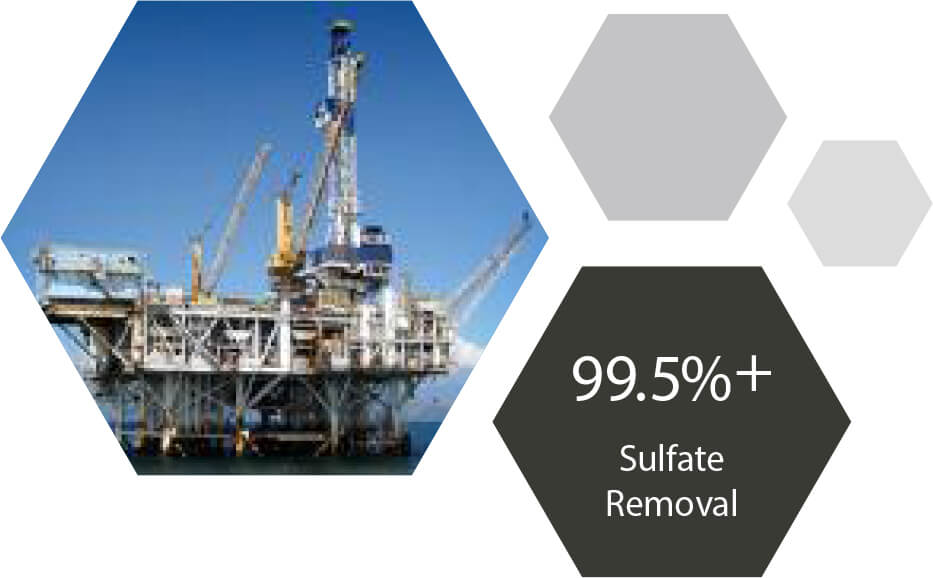
The oil and gas industries have come under increased pressure to find cost effective methods to control the formation of scale in their use of seawater.  The removal of sulfate, which has roughly an 8% concentration in sea water, is the key step for scaling reduction at offshore platforms.  If untreated seawater is mixed with formation water, which contains barium and strontium, significant barium and strontium sulfate scaling and reservoir souring can occur.  The use of nanofiltration membranes with high sulfate rejection and monovalent and divalent ion selectivity would be a cost effective method for achieving sulfate removal.  Synder’s NFW membrane was evaluated against a leading competitor’s NF membranes for sulfate removal in synthesized seawater.  

Feed Solution, Membrane, Operating Parameters 
Table 1: Composition of Synthesized Water 

 Ions  Concentration (mg/L)
 Sodium  11,200 
 Potassium  370
 Calcium   400
 Magnesium  1,400
 Bicarbonate  140
 Sulfate  2,650
 Chloride  19,963
 TDS  36,123

Table 2: Operating Conditions and Membrane Specifications

 Feed Solution  
 Material  Synthesized Seawater
 Conductivity (ms/cm)  70
 pH  6.8-7.6
 Temperature (°C)  8-25
 Synder Membrane  
 Element  NFW-2-2540HF
 Spacer Size (mil)  31
 Surface Area (ft2)  28
 Competitor’s Membrane  
 Spacer Size (mil)  30
 Surface Area (ft2)  27
 Operating Parameters  
 Element Inlet Pressure (PSI)  110
 Pressure Drop (PSI)  10-15
 Crossflow Rate (GPM)  4.5-5.1
 Run Time   165 minutes
 Feed Volume (Gal)  15

Results 
The membranes were tested for permeate flux, sulfate rejection, permeate sulfate concentration, and overall salt rejection (based on conductivity).  Sulfate concentration was determined by a USEPA approved turbidimetric method for both permeate and feed samples via a HACH spectrophotometer.  Based on the information displayed in Table 3 below, the two membranes have similar water flux and MgSO4 rejection under the same conditions (110 psi, 25 °C, ~5 GPM crossflow rate, 2000 ppm MgSO4). 

Table 3: Performance Results

Filtration Results NFW Leading Competitor
Average Permeate Flux (GFD) 28 20
Sulfate Rejection (%) >99 <97.5
Sulfate Concentration in Permeate (mg/L) <30 >50
Overall Salt Rejection (%) 20 26

Conclusion   
In this trial, Synder’s NFW membrane outperformed the leading competitor in removing sulfate from synthetic seawater.  While the membranes showed similar water flux and MgSOrejection under the same operating conditions, the NFW showed greater than 99% sulfate removal efficiency with less than 30 mg/L SO4   in the permeate.  In addition to the higher sulfate rejection and selectivity, the NFW membrane displayed a 40% higher steady state flux than the competitor’s NF membrane.  This combination of greater flux and improved rejection suggests that Synder’s NFW is well suited for seawater sulfate removal.